
Products
Powder dosing looks simple on paper. In practice, it is one of the hardest problems in packaging engineering. Anyone evaluating an automatic powder packing machine for pharmaceuticals, protein powders, or probiotics eventually runs into the same question: how does the machine keep every sachet within weight tolerance when the material itself refuses to behave consistently? This article breaks down the metering mechanism behind a single/double-lane powder stick packer, the LC240B, and explains why the answer sits less in the hopper and more in the screw.
Granules and beads move predictably. They settle, they pour, they behave roughly the same way every time you fill a cup with them. Fine powders do not. Spirulina, milk powder, notoginseng powder, and pharmaceutical actives vary in particle size, moisture content, and static charge from batch to batch, sometimes from hour to hour. That variability is why volumetric filling systems built for granules often struggle when switched to powders—the fill volume stays constant, but the mass inside that volume keeps shifting.
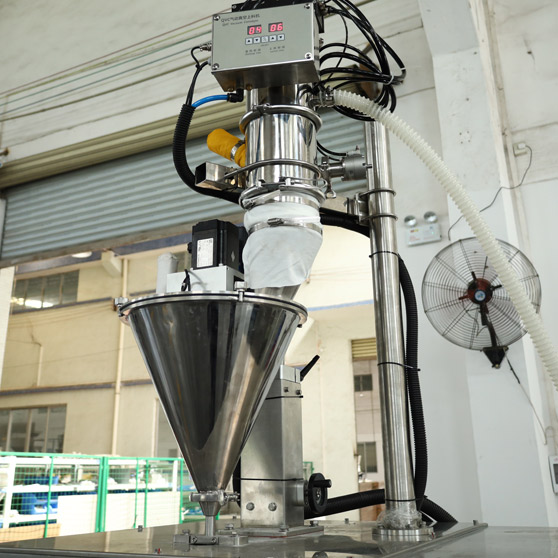
This is the reason auger, or screw, metering exists as a category of its own. A rotating screw inside a tube moves powder forward in a controlled, repeatable path, and dosing becomes a function of rotation count rather than gravity-fed volume. The LC240B uses custom long screws sized to the product, which matters more than it sounds—a screw pitch tuned for coffee powder will not behave the same way with a fluffy, low-density material like spirulina. Getting that geometry right is closer to calibrating a pipette than filling a bucket.
A screw that meters accurately at low speed can still lose accuracy at high speed if the motor driving it drifts even slightly from the film-pulling and sealing motors. The LC240B addresses this through a bus-based servo system, where the metering, film-feed, and sealing motors communicate over a shared control network instead of running as isolated drives. That coordination is what allows the machine to sustain up to 80 cuts per minute, and up to roughly 7,200 bags per hour when configured in double-lane mode, without each bag drifting slightly off from the last one. Speed without synchronization just produces fast inconsistency.
The engineering translates into a few concrete, felt differences on a production floor:
| Parameter | Specification |
|---|---|
| Lanes | 1 or 2 |
| Speed | 20–80 cuts/minute |
| Film roll width | Up to 240mm |
| Bag size | 16–50mm (W) x 40–160mm (L) |
| Seal types | Back seal, triple seal, four-sided seal |
| Contact parts | SUS316 stainless steel |
| Frame material | SUS304 stainless steel |
The seal type is worth pausing on. A four-sided seal generally suits pharmaceutical sachets that need a flatter, more display-friendly format, while a back seal is common for high-speed beverage powder sticks like instant coffee or milk tea mix, where line speed usually outweighs shelf presentation.
Does a higher cuts-per-minute rating always mean better output?
Not necessarily. Rated speed assumes ideal powder flow characteristics. A fine, static-prone powder may need to run below the machine’s maximum to hold accuracy, so the realistic figure depends on the material being packed, not just the spec sheet.
Can auger metering handle very fine or fluffy powders like spirulina or milk powder?
Generally yes, provided the screw geometry is matched to that specific product’s bulk density. This is why custom screw sizing, rather than a single universal screw, tends to produce more consistent results across a wide product range.
Powder packaging problems rarely come down to one dramatic failure. They show up as a slow accumulation of slightly-off sachets, a jammed film roll at 2 a.m., or a batch report that does not quite match the target weight. An automatic powder packing machine built around precise screw metering and synchronized servo control is designed to remove those small, cumulative errors before they become a line stoppage or a compliance issue. For us, that reliability—GMP-compliant construction, SUS316 contact parts, and dosing accuracy that holds up across pharmaceutical, food, and specialty powder applications—is the actual measure of whether an automatic powder packing machine performs, not just the top speed printed on its spec sheet.
Relevant Recommendation
PRODUCTS
Guangdong Coretamp Packaging Machinery Co., Ltd.
CONTACT