
Products
Choosing a powder packaging machine requires a deep understanding of how physical particles behave under pressure and motion. Fine powders present unique challenges compared to granules or liquids because their flow properties change with humidity and aeration. For us, the priority lies in matching the dosing mechanism to the specific density of your product.
Powder flowability is the primary factor that determines how a packaging system should be configured. Some powders are free-flowing, while others are cohesive and tend to bridge or clump inside the hopper. Non-free-flowing materials require active agitation to ensure they move through the system without interruption or inconsistent dosing.
Bulk density also plays a critical role in the mechanical design of the filling tubes. If the density varies significantly between batches, the volume delivered by the machine will fluctuate, leading to underweight or overweight packages. Operators often use vibratory systems after filling to settle the powder in the bag before the final sealing stage, preventing product entrapment in the seal area.
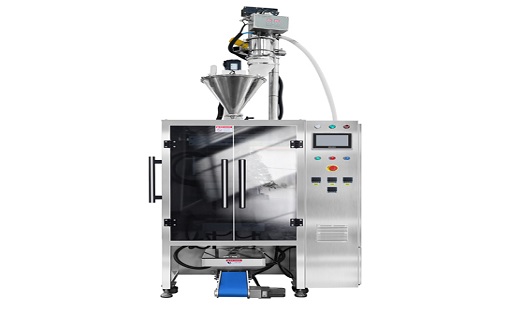
Auger fillers are the standard choice for handling fine powders due to their volumetric accuracy and ability to contain dust. The system works by rotating a screw within a funnel to deliver a precise volume of material. Adjusting the rotation speed and the pitch of the auger allows for minute control over the weight.
Precision depends on maintaining a consistent material head above the screw and using a positive shut-off device to prevent drips. While the clearance between the screw and tube must be carefully controlled, too tight a gap can shear particles, and the primary source of “dribble” is actually material flow after the auger stops, not an oversized clearance. Modern vertical form fill seal systems integrate these fillers directly into the main control loop for real-time adjustments.
Dust is the enemy of a clean seal and a safe working environment. Fine particles can migrate into the sealing jaws, preventing the heat from creating a hermetic bond. This often leads to leaks that compromise the shelf life of the product and cause significant waste during production.
Effective dust extraction systems are integrated into the forming tube to pull airborne particles away from the seal area. Using static elimination bars can also prevent powders from clinging to the film via electrostatic charges. These technical adjustments ensure that the powder packaging machine operates at peak efficiency without constant manual cleaning.
| Feature | Auger Filling System | Cup Filling System | Net Weighing System |
|---|---|---|---|
| Material Suitability | Fine, non-free-flowing powders | Free-flowing granules and powders | High-value, inconsistent density |
| Dosing Accuracy | High (+/- 1% or better) | Moderate | Very High |
| Dust Containment | Excellent (enclosed) | Poor (open) | Moderate |
| Changeover Speed | Moderate (requires cleaning) | Fast | Fast |
The sealing process must account for the presence of micro-particles in the atmosphere. Constant heat sealing is often used for thinner films, while impulse sealing provides better control for thicker, laminated materials because it clamps the seal until it cools. For us, the focus is on the pressure applied by the jaws during the cooling phase.
Programmable logic controllers allow for precise timing of the jaw closure, ensuring that the film reaches its melting point without burning. If the cooling time is insufficient, the seal may fail under the weight of the powder as the bag drops. A stable, continuous process reduces labor costs and increases the overall production efficiency of the facility.
Why is my powder bridging in the hopper?
Bridging occurs when particles lock together to form an arch over the outlet. This is common in cohesive powders with high moisture content. Using a hopper with an integrated agitator or vibrator usually solves this mechanical blockage.
How can I reduce the “bloating” of finished bags?
Powders often trap air during the filling process, leading to puffy bags that are difficult to box. Installing a deaeration device compacts the powder and removes excess air. For products that also require extended shelf life, a gas-flushing system can then replace the remaining air with nitrogen.
The cleaning advice provided in this article is based on general industrial equipment knowledge and is for reference only. For specific maintenance protocols, please consult the technical manual provided with your hardware.
Effective integration of a powder packaging machine transforms a messy process into a streamlined production line. By understanding the interaction between particle physics and mechanical force, businesses can ensure consistent weight accuracy and hermetic seals. Investing in a powder packaging machine built on vertical form fill and seal technology allows your operation to maintain a competitive advantage through reliability and high-speed throughput.
Relevant Recommendation
PRODUCTS
Guangdong Coretamp Packaging Machinery Co., Ltd.
CONTACT