
Products
In the modern manufacturing landscape, the drive for higher throughput often meets the rigid constraints of floor space and labor availability. High-volume producers of granular goods, such as sugar, coffee, and pharmaceuticals, face a recurring challenge: how to scale output without compromising the precision of individual doses. This is where the vertical fill form and seal packaging machine proves its worth, transitioning from a simple utility to a cornerstone of industrial efficiency.
Traditional single-lane systems, while reliable, eventually hit a physical ceiling in speed. Increasing production typically meant adding more machines, which consumed valuable real estate and required more operators. For us, the solution lies in multi-lane technology, which multiplies capacity within a single footprint. By integrating multiple channels into one vertical fill form and seal packaging machine, a facility can achieve the output of ten separate units while managing just one piece of equipment.
Achieving consistency across ten lanes requires more than just repeating a single mechanism. It demands a synchronized orchestration of film tension, filling accuracy, and sealing temperature. A core engineering hurdle in these systems is the “swing measuring cup” system. Unlike traditional volumetric fillers that might struggle with high-speed fluctuations, this specialized assembly uses SUS316L stainless steel components to ensure that every sachet receives the exact same volume of material.
The precision is further bolstered by individual lane adjustments. This allows technicians to fine-tune the output of a single lane without halting the entire production run. Such granularity in control prevents the “all-or-nothing” downtime that plagues older, less sophisticated models. When dealing with high-value pharmaceutical granules, this level of control is not just a luxury; it is a prerequisite for regulatory compliance and cost containment.
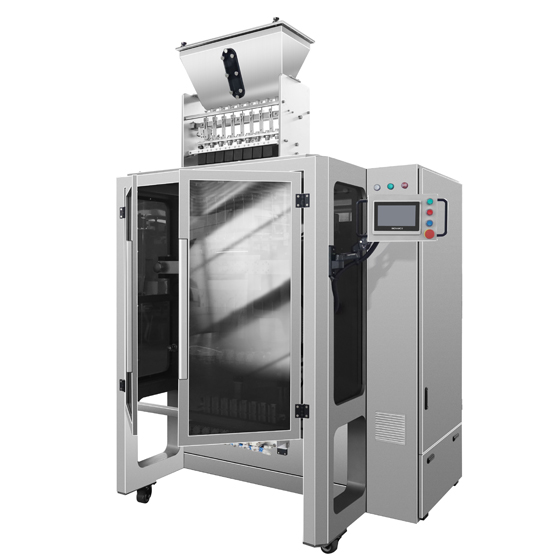
Many facility managers find that as they increase speed, the quality of the seal begins to degrade. This occurs because the film has less time to bond under heat. Modern vertical fill form and seal packaging machine designs counteract this through advanced bus servo systems. These servos provide rapid response times and high operational accuracy, ensuring the sealing jaws engage with perfect timing and consistent pressure, even at 80 cuts per minute.
Furthermore, automatic deviation correction and film breakage detection serve as critical safeguards. In a 10-lane environment, a single film misalignment could result in hundreds of wasted sachets within minutes. By automating the tracking of color sensors, the machine maintains perfect pattern alignment across all channels simultaneously. This reduces material waste and ensures that the final product meets the aesthetic standards expected in retail environments.
To better understand the operational capacity of these systems, we can examine the technical parameters of a high-capacity 10-lane model. These figures demonstrate the balance between speed and precision required for industrial-scale granule packaging.
| Feature | Specification |
|---|---|
| Lane Configuration | 10 Parallel Channels |
| Metering System | Swing Measuring Cup (SUS316L) |
| Production Speed | 20 – 80 cuts per minute |
| Maximum Film Width | 800 mm |
| Bag Dimensions | Width: 16-50mm; Length: 40-160mm |
| Power Requirement | 220V 1P 50/60HZ / 11KW |
| Total Weight | 1400 KG |
The shift toward Industry 4.0 has changed how we view packaging hardware. A vertical fill form and seal packaging machine is no longer an island of automation but a node in a connected factory. With Ethernet connectivity, these machines integrate directly with SCADA and MES systems. This allows for real-time monitoring of throughput, error rates, and maintenance needs from a centralized dashboard.
Hygiene and durability remain non-negotiable, particularly in food and medical sectors. The use of SUS304 stainless steel for the external frame and SUS316 for contact parts ensures full compliance with GMP and CE certification standards. This material choice prevents corrosion from acidic granules or frequent washdowns, extending the operational life of the equipment while maintaining a sterile packaging environment.
Does increasing lanes affect the accuracy of the fill?
No, provided the machine uses independent metering for each lane. In high-quality multi-lane systems, the swing cup system ensures each channel operates with its own calibrated volume.
What types of film are compatible with these machines?
Most vertical systems are designed for versatility, handling laminate films like OPP/CPP, OPP/PE, and BOPP/VMPET/PE with thicknesses ranging from 0.06 to 0.1 mm.
How does the machine handle dust in granular products?
The closed cabinet design and precision nozzles minimize dust escape. For highly dusty materials, integrated vacuum or dust extraction ports are often utilized to keep the sealing area clean.
In conclusion, the decision to invest in a multi-lane vertical fill form and seal packaging machine is a decision to future-proof a production line. By addressing the fundamental challenges of scaling—space, accuracy, and labor—these systems provide a clear path to increased profitability. For us, seeing these machines operate at peak efficiency is the ultimate validation of precise engineering and thoughtful design.
Relevant Recommendation
PRODUCTS
Guangdong Coretamp Packaging Machinery Co., Ltd.
CONTACT