
Products
Manufacturers transitioning to an automatic detergent powder packaging machine often face a steep learning curve regarding powder density and flow characteristics. Fine chemical particulates behave differently than granules, demanding precision in both metering and sealing to prevent product waste. Achieving a consistent fill rate requires a deep understanding of how atmospheric moisture affects detergent flow within the hopper.
The challenge of dust management remains a primary concern for high-volume production lines. Inconsistent sealing caused by powder residue in the heat-seal area can compromise shelf life and structural integrity. For us, addressing these micro-leaks involves integrating specialized dust extraction systems directly into the filling transition.
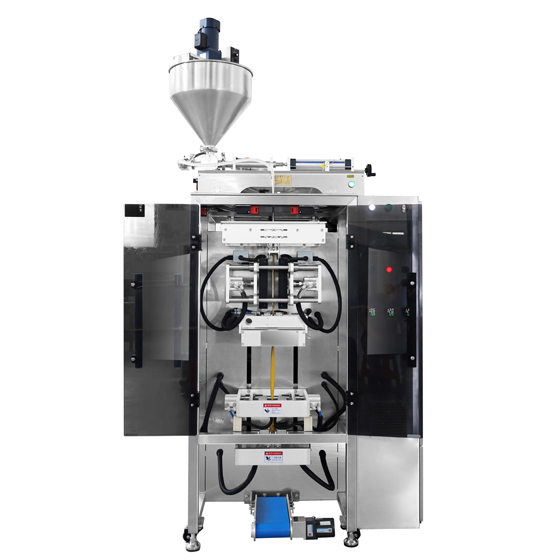
Vertical form fill seal (VFFS) systems have become the industry standard for this application due to their compact footprint and gravity-assisted filling. By utilizing a vertical drop, the machine minimizes the distance the powder travels, reducing air entrapment and preventing powder from contaminating the heat-seal area. When combined with integrated static elimination bars and anti-static film treatment, this architecture helps create a controlled environment where electrostatic charges are neutralized to prevent powder from sticking to the film.
Choosing between an auger filler and a volumetric cup filler depends largely on the specific gravity and flow characteristics of the detergent. Auger fillers are generally preferred for fine powders because the screw rotation can be precisely controlled, and when combined with a tight-tolerance tube or a positive shut-off mechanism, the system provides a mechanical constraint that prevents “flooding” or uncontrolled flow. This ensures that every cycle delivers a predictable volume of product into the forming tube.
| Feature | Auger Filler | Volumetric Cup Filler |
|---|---|---|
| Material Suitability | Fine, non-free-flowing powders | Free-flowing granules and coarse powders |
| Accuracy Level | High (within ±1%) | Moderate |
| Dust Control | Enclosed system | Partially open |
| Changeover Speed | Moderate | Fast |
Precision dosing prevents the “overfill” problem that quietly erodes profit margins over millions of cycles. A variance of just two grams per bag might seem negligible during a single shift. However, across a year of continuous operation, this discrepancy represents tons of lost product that could have been converted into revenue.
The film material used in an automatic detergent powder packaging machine must withstand both chemical interaction and physical stress. Detergents often contain surfactants that can degrade certain polymer layers over time if the barrier properties are insufficient. Laminated films with specialized sealant layers are required to maintain a hermetic seal against these aggressive chemical agents.
Heat-seal parameters—temperature, pressure, and dwell time—must be synchronized with the film’s melting point. If the temperature is too high, the film may “burn” or thin out, creating a weak point. Conversely, insufficient heat results in a “cold seal” that will likely fail during transit or stacking in a warehouse.
Modern systems utilize PLC-controlled PID loops to maintain temperature stability within one degree of the set point. This level of control is necessary when operating at speeds exceeding sixty bags per minute. At these rates, even a momentary drop in heater performance can result in dozens of rejected units.
Digital transformation has moved from a luxury to a requirement for competitive manufacturing. Connecting packaging hardware to SCADA or MES platforms allows for real-time monitoring of OEE (Overall Equipment Effectiveness). Technicians can identify bottlenecks or mechanical wear before they lead to catastrophic failure.
Remote diagnostic capabilities reduce the need for on-site technician visits, which is critical for global supply chains. To support local operators, multiple operation languages are often integrated into the touch screen interface along with standardized communication protocols. This ensures that error messages and maintenance prompts are understood clearly and that complex settings can be managed with minimal training.
Clear communication between the machine and the human operator is the first line of defense against downtime. When alerts and operating parameters are presented in the operator’s native language, response accuracy improves and troubleshooting becomes faster.
How does moisture affect the packaging process?
Detergent powder is hygroscopic, meaning it absorbs moisture from the air, which leads to clumping. Clumped powder can jam the auger filler or cause inconsistent bag weights. Maintaining a humidity-controlled environment, using heated hopper agitators, or blanketing the product with dehumidified air can mitigate these risks.
Can one machine handle multiple bag sizes?
Yes, though it typically requires changing the forming shoulder and adjusting the film tracking. While the VFFS architecture is versatile, dedicated forming sets are necessary to maintain the professional aesthetic of different bag widths.
What is the typical lifespan of wear parts?
Sealing jaws and cutting blades are the most frequently replaced components. Their lifespan depends on the abrasiveness of the powder and the thickness of the packaging film. Regular lubrication and cleaning of the sealing surface can extend these intervals significantly.
Proactive maintenance schedules should be based on cycle counts rather than calendar days. Moving parts like bearings and drive belts experience wear proportional to the machine’s speed and load. A machine running at maximum capacity for three shifts requires a much more aggressive lubrication schedule than one used intermittently.
The evolution of the automatic detergent powder packaging machine has turned it into a sophisticated data node within the factory. Reliability is no longer just about mechanical strength but about how well the system adapts to varying inputs. Precision in every seal ensures that the final product reaches the consumer exactly as intended.
The operational performance data and maintenance intervals discussed in this article are based on general industrial knowledge of chemical packaging and are for reference only. Specific machine settings and chemical compatibility must be validated by your equipment manufacturer and guided by your material safety data sheet (MSDS) protocols.
Effective throughput is the result of aligning material science with mechanical precision. By optimizing the interaction between the auger filler and the sealing jaws, manufacturers can achieve a stable, high-speed output. Investing in an automatic detergent powder packaging machine that prioritizes these technical details is the most direct path to sustainable growth in the competitive cleaning products market.
Relevant Recommendation
PRODUCTS
Guangdong Coretamp Packaging Machinery Co., Ltd.
CONTACT