
Products
Production floors in the confectionery industry often face a quiet, wooden bottleneck. While ice cream freezing tunnels operate at lightning speeds, the final secondary packaging stage frequently lags. An efficient ice cream stick packing machine transforms this chaotic manual sorting into a streamlined, high-speed flow.
Manufacturers must realize that consistency is the primary driver of retail success. A single misaligned stick can jam downstream equipment, leading to costly downtime. Modern systems solve this by utilizing precision sensors to verify every unit before it enters the film.
Manual labor introduces variability that a high-speed production line cannot tolerate. Human operators tire, lose focus, and eventually struggle to maintain the 100-plus units per minute requirement. This inconsistency often results in inconsistent seal integrity, which compromises the hygienic barrier of the product.
Relying on physical touch also increases the risk of microbial contamination. In a food-grade environment, minimizing human contact is not just a preference, it is a safety mandate. Automated systems ensure that the product remains untouched from the moment it leaves the freezer.
A multi-lane ice cream stick packing machine functions like a well-orchestrated symphony of servos. The primary feed system aligns the sticks, ensuring they are oriented correctly for the wrapping phase. For us, providing multi-lane stick packaging solutions means handling various solid stick‑based products with the same precision expected from traditional ice cream stick lines.
The vertical form fill seal (VFFS) process is the heart of this operation. It forms the pouch from a roll of film, inserts the stick, and seals it in one continuous motion. This integration reduces the footprint of the machinery on the crowded factory floor.
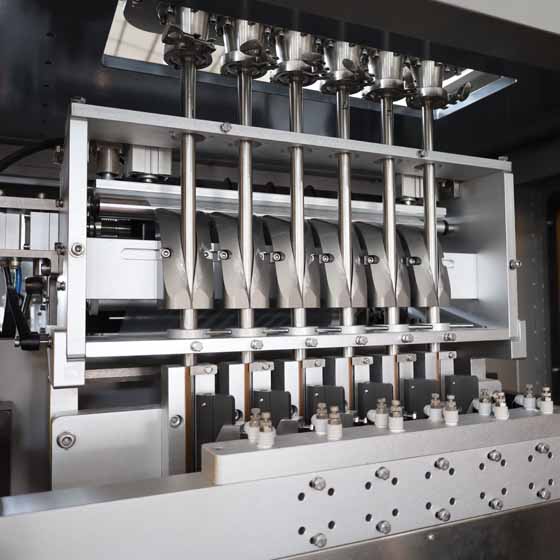
Speed is useless if it comes at the cost of hygiene. Most high-tier machines are constructed from 304 or 316 stainless steel to withstand rigorous washdown procedures. The smooth surfaces prevent the accumulation of organic debris, which could otherwise foster bacterial growth.
| Technical Specification | Standard Configuration | High-Speed Configuration |
|---|---|---|
| Packing Speed | 40 – 80 ppm | 100 – 180 ppm |
| Film Width | Up to 320mm | Up to 450mm |
| Bag Length | 50 – 200mm | 50 – 300mm |
| Air Pressure | 0.6 MPa | 0.8 MPa |
Technical precision in the sealing temperature is equally critical. If the heat is too low, the seal will fail; if it is too high, the film may melt. Advanced PID controllers manage these temperatures within a fraction of a degree.
The initial capital expenditure for an ice cream stick packing machine can seem daunting. However, the reduction in labor costs usually yields a return on investment within eighteen months. By replacing four manual packers with one automated system, the factory significantly lowers its overhead.
Furthermore, material waste is drastically reduced through precise film tensioning. Manual wrapping often results in excess film usage or frequent tears. Automated rollers maintain constant tension, ensuring that every centimeter of film is used effectively.
How do I prevent film tracking issues?
Ensure that the film roll is centered on the spindle and that the tension rollers are clean. Even a small buildup of adhesive can pull the film to one side.
Why are my seals leaking?
Check the pressure of the sealing jaws. Often, the serrated teeth of the jaws become clogged with product residue, preventing a flush contact.
Can one machine handle different stick sizes?
Yes, but it usually requires a changeover of the forming tube. Modern machines are designed for quick-tooling swaps to minimize transition time between batches.
How does humidity affect the packaging process?
High humidity can make the film “sticky,” increasing friction against the forming plates. Climate control in the packaging room is often necessary for optimal performance.
The transition to an automated ice cream stick packing machine is an investment in future stability. As market demands fluctuate, the ability to scale production upward without increasing headcount becomes a competitive advantage. High-precision packaging is the final touch that ensures a premium product reaches the consumer.
The technical advice provided in this article is based on general industrial packaging knowledge and is for reference only. For specific machinery configurations or safety protocols, please consult your equipment manufacturer or a certified industrial engineer. By focusing on mechanical reliability and sanitary design, producers can master the complexities of the ice cream stick packing machine.
Relevant Recommendation
PRODUCTS
Guangdong Coretamp Packaging Machinery Co., Ltd.
CONTACT